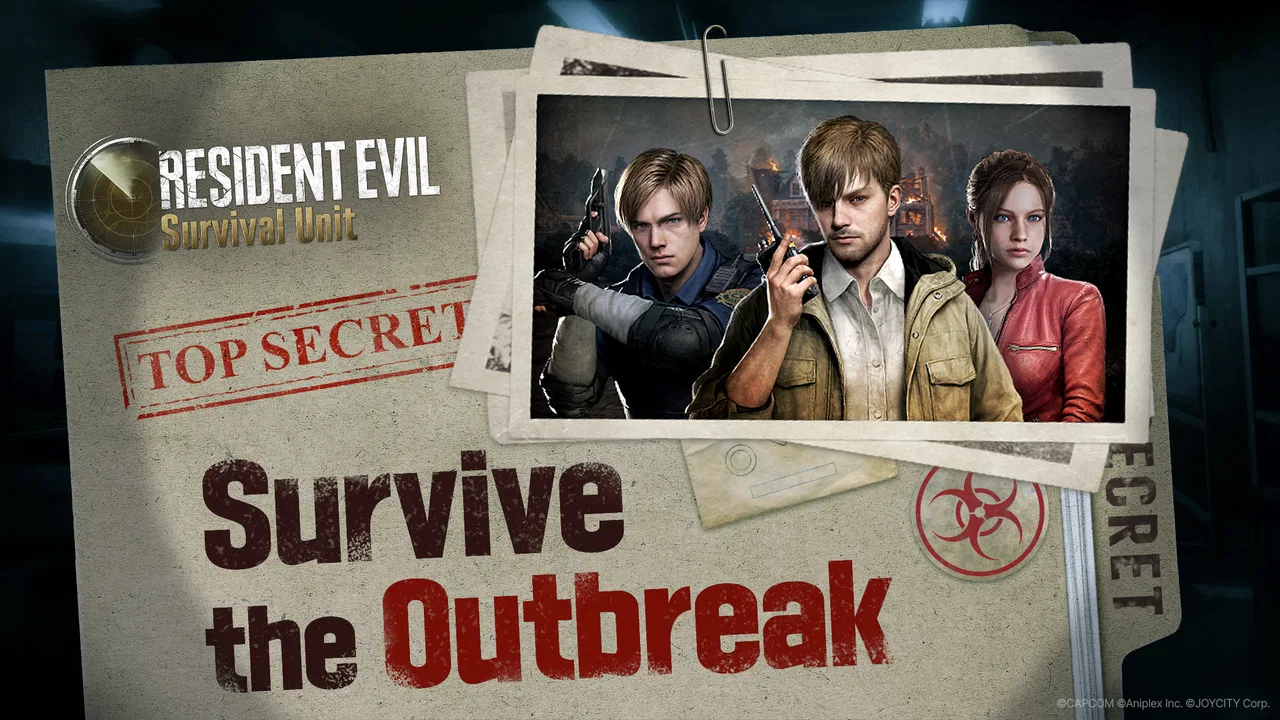
Resident Evil Survival Unit
- 4.3
- Rating
- 5.00M
- Installs
- Free
- Price

 Analysis by App-foxy
I went into Resident Evil Survival Unit expecting a strategy game wearing the Resident Evil name, and that is exactly the right way to approach it. This is not simply a fast action game with a horror skin. Its appeal comes from making survival feel like a planning problem: what to develop, when to commit resources, and how patiently to build an advantage instead of chasing every immediate reward. Aniplex Inc. presents it as a free game for Android, with a Teen content rating and optional purchases ranging from $0.99 to $99.99 per item.
After spending time with it, I found the most interesting question was not whether it looks like Resident Evil, but whether its strategy structure gives the setting a reason to exist. For me, the answer is mostly yes. The atmosphere and recognizable universe make the early hours easier to enter, while the strategic layer gives the game a longer-term purpose. Still, this is a better fit for players who enjoy steady planning than for someone looking for a compact horror experience they can finish in a few short sessions.
How the game feels when you first start planning
The opening impression is important because strategy games can feel slow before their systems become meaningful. Here, I noticed that the game asks me to think ahead rather than simply react. That changes the rhythm from the beginning: I am not only asking what can be done immediately, but whether an action will help me several steps later. The Resident Evil setting gives those decisions a little more tension than a completely abstract strategy game would.
You May Also Like

 Blood Strike: 2.5 Anniversary
Blood Strike’s Loadouts Turn Every Drop Into a Tactical Gamble
A close look at Blood Strike’s custom loadouts: how fast access to signature weapons reshapes its battle royale rhythm, rewards preparation, and narrows the gap between fights.

 Pandora - Music & Podcasts
Pandora’s Music Is Easy to Start, but Harder to Recover
Pandora’s strength is its low-effort path from a seed to a station. Its weak spot is how much confidence it asks you to place in connection, setup, and quiet recovery.

 8 Ball Pool
 Is Built on Rivalries, Rematches, and Routine
A close look at the rivalries, rematches, shared routines, and unanswered safety questions that turn a quick pool match into a persistent mobile community.

 Samsung Music
’s Quiet Strength Is Playing What You Already Own
Its reach comes less from spectacle than from dependable access to a personal library. That simplicity is both the app’s strongest retention engine and its ceiling.

 AccuWeather: Weather Radar
AccuWeather Review: A Quick, Clear Forecast for Everyday Decisions
For everyday plans, the best forecast is the one you can understand quickly. AccuWeather makes rain timing, radar, and local conditions easy to act on, with a few trade-offs.

 Hill Climb Racing
Why Hill Climb Racing Still Turns Crashes Into One More Run
A tiny car, a bumpy hill and one more upgrade: Hill Climb Racing keeps resurfacing because its simple chaos makes every near-miss feel personal.
More From Our News Desk



The store summary describes strategy as the key to survival, and that idea is a useful guide for new players. I would not treat every visible objective as equally urgent. My better results came from choosing a small priority, completing it, and then checking what it unlocked or improved before spending again. That habit prevents the common mistake of scattering resources across too many goals and then feeling weak everywhere.
The game is currently at version 1.4.5, which matters to anyone joining after launch because the experience is not necessarily the same as an untouched first release. I still recommend taking the first sessions slowly. The temptation in a free strategy game is to hurry every timer or purchase a shortcut, but learning which improvements actually affect your next obstacle is more valuable than moving quickly for its own sake.
One practical tip helped me more than it sounds: I treated every new resource as a decision rather than as money to spend. Before confirming an upgrade, I asked whether it would solve a present problem, open a useful route, or merely make a number look better. That simple pause makes the game feel less like a sequence of taps and more like a survival campaign with consequences.
Why the pace may suit some players and frustrate others
The perceived speed depends heavily on what you want from a strategy game. If you enjoy checking progress, making a decision, and returning later to reassess, the measured rhythm can feel comfortable. It gives the setting room to breathe and makes preparation part of the fantasy. If you want constant combat or a quick burst of horror, the same rhythm may feel like a barrier between you and the action.
I also found that the game is easier to enjoy when I play it in deliberate windows instead of expecting it to fill an entire evening. A short morning check can be useful for reviewing priorities, while a longer session works better when I have enough attention to compare choices. That is a more satisfying routine than opening it repeatedly without a plan and wondering why progress feels scattered.
Compared with a traditional action-focused Resident Evil title, this game asks for more patience and less hand-eye reaction. Compared with a typical strategy game without a strong fictional identity, it has a clearer mood and a more recognizable reason to keep developing. Neither comparison makes it automatically better; it simply explains where the game sits. I would choose it over a generic strategy title when atmosphere matters, but I would choose an action game when I want immediate control and a dramatic sequence rather than preparation.
What happens when the session becomes demanding
The heavier moments are not necessarily the moments with the most visual activity. They are the points where several decisions compete for the same limited attention. A new objective may look attractive while an older development path is still unfinished, and choosing badly can leave the whole plan feeling inefficient. I learned to review the overall direction before reacting to the newest prompt.
That approach is especially useful for players who tend to spend resources as soon as they receive them. In my experience, holding something back can be strategically stronger than completing the first available improvement. A reserve gives me room to respond when the next requirement is more important than the one currently on screen. This is one of the game’s less obvious lessons: survival is often about flexibility, not maximum short-term growth.
During a busy session, I also recommend avoiding multitasking with several unrelated goals. The game becomes mentally heavier when I jump between development, progression, and collection decisions without finishing a line of thought. I got more from it by grouping actions: first review what is blocked, then choose one path, then spend only what supports that path. That workflow reduces the feeling of noise and makes the strategic results easier to understand.
Players who enjoy optimization will probably appreciate this layer. Someone who dislikes waiting, revisiting plans, or accepting that a choice may be merely adequate rather than perfect may find the same structure tiring. The game does not need to be difficult in every moment to demand concentration; its pressure comes from making the player decide what deserves attention now.
Stability, recovery, and the practical side of playing
My view of reliability here is less about dramatic surprises and more about how comfortably the game supports a repeated routine. A strategy title needs to make returning feel worthwhile. If I leave after setting a priority, I want the next session to begin with a clear sense of what I was doing rather than forcing me to reconstruct the entire plan from memory. I found that keeping one simple objective in mind made recovery from an interrupted session much easier.
That is also why I would avoid beginning a complicated decision while distracted or about to leave the game. The safest routine is to finish reviewing the current task before closing, then return later with a fresh look. It sounds basic, but it prevents impulsive spending and reduces the chance of forgetting why a particular upgrade was chosen.
New players may reasonably wonder whether the game can be enjoyed without paying. It is free to start, and optional purchases are present, so I approached it as a game that asks for patience rather than assuming every delay should be removed. My advice is to play naturally first and wait before buying anything. If the planning loop itself is not enjoyable, a purchase will not repair that problem. If the loop works for you, you can decide later whether convenience is worth the cost.
The price range deserves attention because the gap between the smallest and largest listed item is substantial. I would set a personal spending limit before getting invested, especially if you are prone to paying to solve a moment of impatience. The strongest reason to spend should be that you genuinely value the game, not that you feel forced to catch up during a frustrating session.
Device limits and what to expect from the install
The game supports Android 6.0 and later, which makes it accessible to a broad range of Android devices on paper. That compatibility does not mean every phone will deliver the same experience. Hardware age, available storage, background activity, and battery condition can all affect how comfortable a strategy game feels over repeated sessions. I would keep the device reasonably clear and avoid judging performance from a single short launch.
Resource demands are also about attention and battery habits, not only graphics. A game that encourages frequent checks can become inconvenient if it heats the phone or drains power during long periods of use. I prefer shorter sessions when the device is already busy, and I close unnecessary background apps before a longer play period. These are sensible precautions rather than guarantees, but they make the experience more predictable.
On an older phone, the most important question is whether the game remains comfortable during the moments when several systems need attention. A brief opening may seem fine while a busier sequence feels less smooth. If your device is close to the minimum operating-system requirement, I would start with modest expectations and avoid filling the phone’s storage completely. Players with newer hardware will have more breathing room, but they should still remember that compatibility is not the same thing as identical performance.
iPhone users should also think about the kind of device they want to use for a long-running strategy game. A larger screen can make planning and reading information easier, while a compact phone may be more convenient for quick checks. The best choice is not necessarily the newest device; it is the one that lets you comfortably inspect the game without rushing through decisions.
Who will get the most from this strategy game
I recommend it most strongly to Resident Evil fans who are willing to experience the universe through planning rather than direct horror action. It is also a good match for people who enjoy building a routine around gradual progress, comparing priorities, and making careful use of limited resources. The setting provides motivation, but the strategy loop has to carry the experience between recognizable moments.
A realistic everyday use case would be a player checking in during a commute, lunch break, or quiet evening, identifying one meaningful objective, and returning later to decide the next step. That pattern suits the game better than trying to force a complete campaign feeling into one sitting. If you have only a few minutes, use them to review and prepare rather than making a rushed purchase or scattering your resources.
I would skip it if you want a self-contained horror story, constant combat, or a game that respects only quick reflexes. I would also be cautious if you dislike free-to-play economies on principle, because optional purchases can change how you think about time and progress even when you do not buy them. In those cases, a premium action game or a focused single-player horror title is likely to be a better choice.
The audience size suggests that the game has found a substantial player base: it has more than a million installs, with an average rating of 4.4 from roughly 95 thousand ratings and about 7 thousand written reviews. Those figures do not replace personal taste, but they do indicate that the concept has attracted real interest. I would still read the game on its own terms rather than assuming popularity means it will suit every Resident Evil fan.
My final performance verdict
For me, Resident Evil Survival Unit works best when I stop expecting a conventional horror adventure and accept its slower strategic identity. Its strongest quality is the way the setting gives planning an emotional frame: preparation feels connected to survival instead of being a collection of disconnected menus. The most useful habit is to choose a clear priority, keep a reserve, and return with a plan instead of reacting to every prompt.
The main friction is equally clear. Players seeking immediate excitement may find the pace restrained, and players sensitive to free-to-play pressure will need firm spending boundaries. Device comfort can vary with hardware and session length, so I would begin with shorter play periods and see how the game behaves on your phone before committing to a daily routine.
Aniplex Inc. has made a strategy game that is more appealing to patient Resident Evil followers than to action-first players. I would recommend trying it free, learning its rhythm, and judging the planning itself before considering any purchase. If that rhythm gives you the same satisfaction it gave me—small decisions gradually becoming a stronger survival plan—then this is worth keeping installed. If you want fear, movement, and immediate drama above all else, choose a different kind of Resident Evil experience instead.
FAQs for Resident Evil Survival Unit
01What is Resident Evil Survival Unit about?
Resident Evil Survival Unit is an action-packed mobile game that combines elements of survival horror and strategy. Players must build and strengthen their base, recruit characters from the Resident Evil universe, and battle hordes of zombies. The game features thrilling missions and an engaging storyline that keeps players on edge.
02Is Resident Evil Survival Unit free to play?
Yes, Resident Evil Survival Unit is free to download and play. However, it offers in-app purchases for various items and upgrades that can enhance gameplay. These purchases are optional, but they can provide a significant advantage in progressing through the game more swiftly.
03What devices are compatible with Resident Evil Survival Unit?
Resident Evil Survival Unit is compatible with both Android and iOS devices. It requires Android version 5.0 or higher and iOS 11.0 or later. Make sure your device meets these requirements to ensure optimal performance and a smooth gaming experience.
04Does Resident Evil Survival Unit require an internet connection?
Yes, an active internet connection is required to play Resident Evil Survival Unit. This is necessary for features like multiplayer battles, updates, and syncing progress across devices. Ensure you have a stable Wi-Fi or mobile data connection while playing to avoid interruptions.
05Are there any age restrictions for playing Resident Evil Survival Unit?
Resident Evil Survival Unit is rated for players aged 17 and older due to its intense violence and mature themes. Parents should be aware that the game contains graphic content typical of the Resident Evil series, making it unsuitable for younger audiences.
Pros
- Immersive graphics enhance gameplay experience.
- Intuitive controls make navigation easy.
- Engaging storyline keeps players hooked.
- Multiplayer mode adds social interaction.
- Regular updates bring new challenges.
Cons
- Requires a stable internet connection.
- Some levels may feel repetitive.
- In-app purchases can be pricey.
- High storage space requirement.
- Battery drain on extended play sessions.

Resident Evil Survival Unit
Gallery